
Small Health HabitsSleepward guide

Updated November 2026 · 5-minute method

Stop replaying tomorrow. Start writing it down.

For anyone whose mind races at bedtime: type each thought, watch the count climb, then pick tomorrow's three.

0things out of
your head

5:00 · starts on first thought
Download on the App Store Free on iPhoneGet Sleepward free

The short answer

How do you brain dump before bed?

Set a five-minute limit, then write every task, worry and reminder on its own line without solving any of them. When time is up, pick at most three things that would make tomorrow easier, park everything else, and close the list. The point is to get it out of your head, not to plan your week.

There's a little research behind the idea. In a 2018 Baylor University study of 57 young adults, published in the Journal of Experimental Psychology: General, people who spent five minutes writing a to-do list at bedtime fell asleep faster than people who wrote about tasks they had already finished.

Before you start

What a brain dump won't do

We'd rather you hear the limits from us.

Five minutes of writing it down beats an hour of carrying it around.

Step by step

The five-minute brain dump, in five steps

Use paper, your notes app or the box at the top of this page.

  1. Set five minutes

    A limit keeps it a brain dump, not a planning session. Five minutes matches what the Baylor researchers used.

  2. One thought per line

    Tasks, worries, "remember to…", half-ideas. Don't sort or solve. If it's taking up space, it goes on the list.

  3. Pick up to three for tomorrow

    One main thing, one small task, one optional extra. Or none at all. Try it on your own list just below.

  4. Park the rest

    Everything else stays on the list, safe until morning. You don't have to remember it, because it's written down.

  5. Close it and wind down

    Shut the notebook or put the phone down. The CDC suggests turning off electronic devices at least 30 minutes before bed.

Tap the label next to each thought: Parked, Main, Small or Extra. One of each, at most.

    Inside Sleepward

    The same brain dump, built into a four-minute evening reset

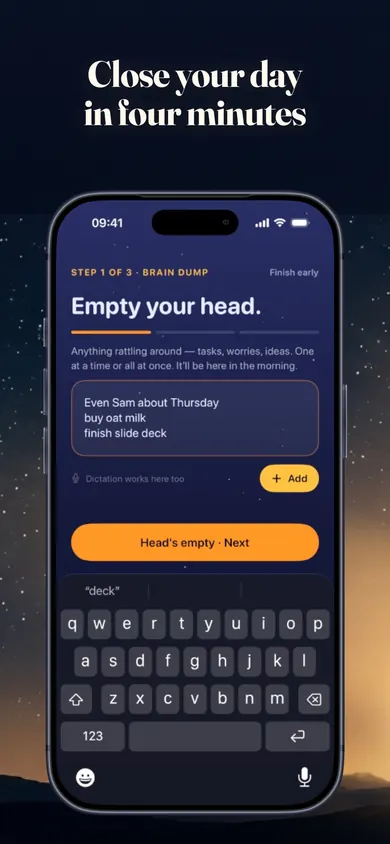
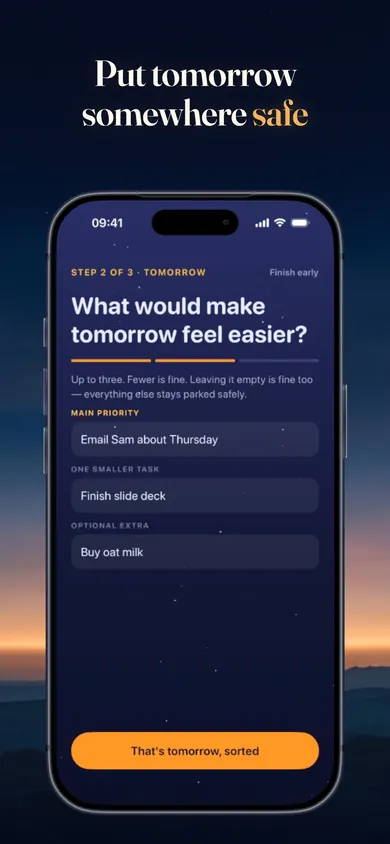
    Sleepward is our bedtime routine app. Its Brain Dump keeps each thought as a separate, private entry you can edit later, then asks the same question this page does: what would make tomorrow easier?

    Sleepward Brain Dump screen titled Empty your head with three separate entries
    Brain Dump: one entry per thought.
    Sleepward screen asking what would make tomorrow feel easier, with a main priority, a smaller task and an optional extra
    Tomorrow's three: main, small, optional.
    Sleepward screen with a sleeping Moon Fox and the words Today is closed
    "Today is closed." The notes wait for morning.

    How it works in the app

    1. Clear your headWrite everything down in a private Brain Dump. Pick up to three things for tomorrow, or none. Everything else stays parked safely for later.
    2. Take Your HourAn optional protected stretch of 15, 30, 45 or 60 minutes that always ends before the bedtime you chose.
    3. Wind downA gradually darkening screen, a routine you can edit, and free white, pink or brown noise with a fade-out timer.

    One design decision: picking zero things for tomorrow is a real option, not an error. Some nights the kindest plan is no plan. Who should pick something else: if you already keep a to-do app you trust, use it for this; a separate bedtime app only helps if you want the whole wind-down, not just the list.

    An example night

    11:15 p.m., wide awake

    Lights off, and then it starts: the dentist call, the birthday card, the thing your manager said, whether you locked the car. Each one loops twice before the next arrives.

    So you sit up and give it five minutes. Nine lines. "Dentist" becomes tomorrow's small task. "Finish the report draft" is the main thing. The birthday card is the optional extra. The other six get parked.

    The car is locked, by the way. You checked, and wrote "car: checked" just to close the loop.

    An illustrative scenario we wrote to show the method, not a real user's story.

    Questions

    Brain dump questions

    Should I brain dump on paper or on my phone?

    Either works. Paper keeps you off a screen; the CDC suggests turning off electronic devices at least 30 minutes before bedtime. A phone is easier to search and edit tomorrow. If you use your phone, do the brain dump first, then put it down for the rest of your wind-down.

    Is a brain dump the same as journaling about my day?

    Not quite. In the 2018 Baylor study, people who wrote a to-do list fell asleep faster than people who wrote about tasks they had already completed. Among the second group, the more detail they wrote, the longer they took to fall asleep. Point the list forward, at tomorrow.

    What if a new thought shows up once I'm in bed?

    Add it to the list in one line and stop there. Don't start solving it. If racing thoughts keep you awake most nights, or you often have trouble sleeping, Mayo Clinic advises contacting your health care provider.

    Sources checked November 2026: CDC, About Sleep (May 2024); Mayo Clinic, Sleep tips (January 2025); ScienceDaily summary of Scullin et al., 2018.

    This is general information, not medical advice. Talk to your clinician. Sleepward is a personal routine and journaling tool, not a medical device; it does not diagnose or treat insomnia or any sleep condition.

    Sleep well,
    the Honest Little Apps studio

    Empty your head. Then let the day end.

    Brain Dump, tomorrow's three and a calm wind-down are free forever. No account, no ads, and your notes stay on your iPhone.

    Download on the App Store Free on iPhoneGet Sleepward free

    More from Small Health Habits