Small Health HabitsBody Unpacked guide

Updated November 2026 · Honest Little Apps

Rank 6 Foods by Vitamin D.

Winter sun may make none. Drag these foods from most to least vitamin D, then check.

Most at topDrag, or use the arrows
    Per serving, from NIH data.
    Download on the App Store Free on iPhoneTry it tonight

    How do you get vitamin D in winter?

    In much of the US, Canada and the UK, winter sunlight is too weak for your skin to make much vitamin D, so food and, for many people, a supplement fill the gap. Fatty fish, UV-exposed mushrooms and fortified milks carry the most. Most other everyday foods carry little or none.

    The NHS says that between October and early March the UK sun isn't strong enough to make vitamin D, and that everyone should consider a daily 10 microgram (mcg) supplement in autumn and winter. In the US, the NIH Office of Dietary Supplements sets the recommended amount at 15 mcg (600 IU) a day for adults 19 to 70 and 20 mcg (800 IU) from 71, and notes those amounts assume minimal sun. The two countries simply use different reference values.

    In winter, vitamin D mostly comes from your plate or a supplement, not the sky.

    Does winter sun make vitamin D where you live?

    A classic 1988 experiment in the Journal of Clinical Endocrinology & Metabolism left skin samples in the sun on clear days. In Boston (42°N), no previtamin D3 formed from November through February; in Edmonton (52°N) the gap ran October through March. At 34°N and 18°N, sunlight still made it in midwinter. Pick the closest latitude to see the months.

    Study conditions: clear days, measured in skin samples. Clouds, older skin, darker skin and sunscreen all reduce production further, per NIH. The UK sits roughly between 50°N and 60°N.

    The further from the equator, the longer your "vitamin D winter".

    The full food list, with real numbers

    From the NIH Office of Dietary Supplements' table of food sources. The Daily Value on US food labels is 20 mcg.

    Food, servingmcgIU
    Cod liver oil, 1 tablespoon34.01,360
    Rainbow trout, farmed, cooked, 3 oz16.2645
    Sockeye salmon, cooked, 3 oz14.2570
    White mushrooms exposed to UV light, ½ cup9.2366
    2% milk, vitamin D fortified, 1 cup2.9120
    Soy, almond or oat milk, fortified, 1 cup2.5–3.6100–144
    Fortified cereal (10% DV), 1 serving2.080
    Sardines, canned in oil, 2 sardines1.246
    Egg, 1 large, scrambled1.144
    Tuna, light, canned in water, 3 oz1.040
    Chicken breast, roasted, 3 oz0.14
    Broccoli, almonds, lentils, rice, bread00

    Source: NIH ODS Vitamin D Fact Sheet for Health Professionals, Table 3, accessed November 2026.

    One serving of salmon carries more vitamin D than a dozen eggs.

    Vitamin D in winter: 11 straight answers

    Can I get vitamin D from the sun in winter?
    Often not much. The NHS says UK sunlight from October to early March isn't strong enough, and a 1988 study found no vitamin D formed in skin samples in Boston from November through February. Closer to the equator, winter sun can still work.
    How much vitamin D do adults need a day?
    The NIH recommends 15 mcg (600 IU) a day for adults 19 to 70 and 20 mcg (800 IU) from age 71. The NHS advises 10 mcg a day for adults and children from age 1. They are different national reference values.
    Should I take a vitamin D supplement in winter?
    The NHS says everyone in the UK should consider a daily 10 mcg supplement in autumn and winter. Whether you need one, and how much, depends on your diet, health and medicines, so ask your clinician or pharmacist.
    Which foods have the most vitamin D?
    In the NIH table, cod liver oil, trout, salmon and UV-exposed mushrooms top the list. Fortified milks and cereals add a few mcg. Eggs, tuna and sardines carry about 1 mcg per serving.
    Does sunlight through a window count?
    No. The NIH says sunlight through a window does not produce vitamin D in the skin.
    Does sunscreen stop vitamin D?
    The NIH says sunscreen with SPF 15 or higher limits vitamin D production. Skin cancer prevention still matters, so most people get vitamin D from food and supplements rather than skipping sunscreen.
    Who is most likely to run low?
    The NIH lists people with limited sun exposure, older adults, whose skin makes less vitamin D, and people with dark skin. The NHS advises a year-round 10 mcg supplement for people who are rarely outdoors, live in a care home or cover most of their skin outdoors.
    Is vitamin D2 or D3 better?
    Both are well absorbed. The NIH health professional fact sheet says D3 raises blood levels more and keeps them higher for longer than D2.
    Can you take too much vitamin D?
    Yes. The NIH upper limit for adults is 100 mcg (4,000 IU) a day from all sources, and the NHS says not to take more than 100 mcg a day. Very high blood levels can cause nausea, vomiting, muscle weakness, confusion and kidney stones.
    Do mushrooms have vitamin D?
    A little, naturally. Mushrooms exposed to UV light can have much more: the NIH lists 9.2 mcg in half a cup of UV-exposed white mushrooms, versus 0.1 mcg in regular portabellas.
    Where does vitamin D go after I eat it?
    It's absorbed in the small intestine with fat, then processed in the liver and kidneys into its active form, which helps your gut absorb calcium. The Body Unpacked atlas covers all 13 vitamins, step by step, with sources.

    Most winter vitamin D questions come down to latitude, food and a conversation with your clinician.

    A December lunch, told plainly

    This is a composite, not a real person. A student in Minneapolis, about 45°N, assumes her daily walk to class covers vitamin D. It's dark when she leaves the library, and her jacket hood is up the rest of the time. She ranks the six foods above and puts eggs first.

    The check puts salmon at the top and eggs fourth. She doesn't change her whole diet. She swaps her plain oat milk for a fortified one, adds a salmon dinner a week, and asks at her campus clinic whether a supplement makes sense for her.

    Knowing which foods carry it turns a vague worry into a shopping list.
    Honest limits

    This page can't tell you if you're low. Only a blood test can show your vitamin D level, and only a clinician can interpret it with your health history.

    Body Unpacked gives no supplement or medication advice. It's an education app: general information, every claim sourced. Its content is checked by the developer against the cited public sources and hasn't been independently reviewed by a clinician.

    Who should pick something else: if you want daily nutrient tracking or a personal vitamin D target, use a tracking app or a registered dietitian. If you have kidney or liver disease, or take medicines, ask your clinician before starting any supplement.

    Learn the "why" here; get the "how much for me" from a clinician.

    How Body Unpacked works

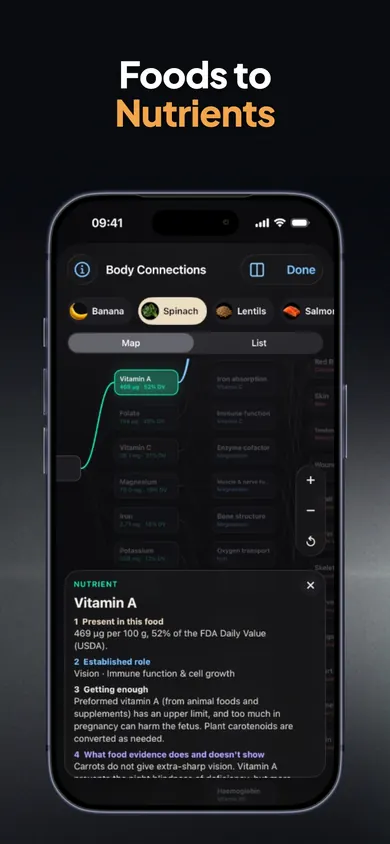
    1. Body Connections graph from spinach to nutrients, with a vitamin A detail card
      Step 1

      Pick a food

      Choose one of 44 everyday foods and watch a graph draw from food to nutrients to roles to body places. Values come from USDA FoodData Central.
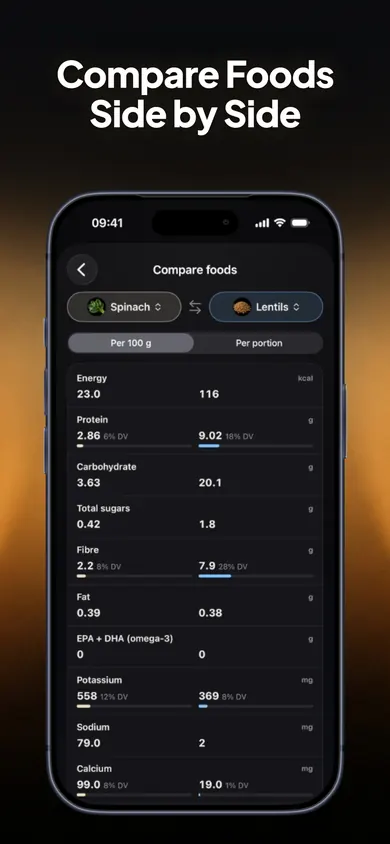
    2. Compare foods screen showing spinach and lentils side by side per 100 grams
      Step 2

      Compare two foods

      Put two foods side by side across 14 nutrients, per 100 g or per portion. No scores, no "healthier" rankings.
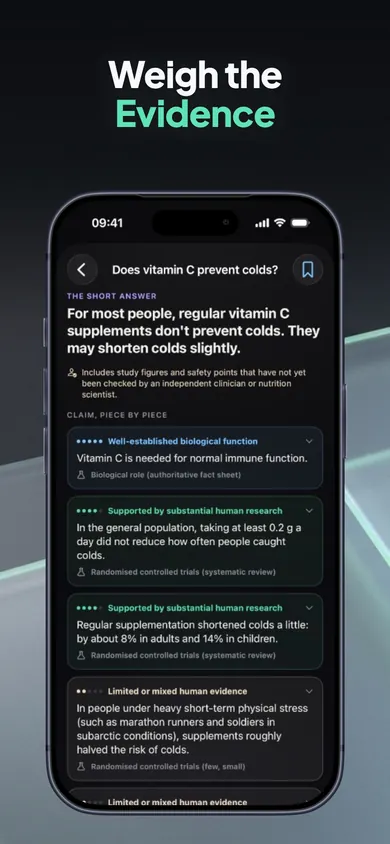
    3. Evidence Lens screen breaking the question does vitamin C prevent colds into labelled claims
      Step 3

      Weigh the evidence

      Evidence Lens breaks popular health questions into statements, each labelled by the kind of evidence behind it and its named source.

    Our design decision: missing data in Body Unpacked shows as missing, never as zero, so a food is never made to look emptier than it is. No account, no ads, no analytics; everything works offline. This is general information, not medical advice. Talk to your clinician.

    Follow a food into your body.

    Free, private and offline, with every claim sourced.

    Download on the App Store Free on iPhoneTry it tonight

    More from Small Health Habits