Small Health HabitsSleepward guide

Mistakes & fixes · Updated November 2026

Stop perfecting bedtime. Start closing the day.

For night owls whose routine never sticks: seven common mistakes, each with a four-minute fix.

Tap the phoneA day, closed in four minutes

Four screens from a real evening reset. Tap to step through.

Download on the App StoreFree on iPhoneStart on your iPhone

Why isn't my bedtime routine working?

Usually because it's too long, starts too late, or leaves your head full. The routines that stick are short, happen at about the same time each night, and close open loops before you lie down. Fixing one or two of the mistakes below matters more than adding another step.

The CDC's sleep tips (last reviewed November 2023) are short for a reason: same bedtime and wake time every day, a quiet, cool room, and devices off at least 30 minutes before bed. Most routine mistakes are ways of making that harder than it needs to be.

A good routine isn't longer. It's finished.

Mini-story: the 45-minute routine

It starts on a Sunday with good intentions: stretch, skincare, journal three pages, read a chapter, tea, lights out by 10:30. By Wednesday it's 11:40, you're too tired to start a 45-minute routine, so you skip the whole thing and scroll instead. By Friday the routine is a source of guilt rather than sleep.

That pattern is the first mistake on this list. The fix is almost boring: make it short enough that a bad night can still finish it.
Seven bedtime routine mistakes, and the fix for each

1

The routine is too long to survive a bad night

StopBuilding a routine for your best evening.

StartA version you can finish in four minutes when you're tired, with extras that are optional.

2

Bedtime moves every night

StopGoing to bed "when I'm tired" and waking whenever the alarm goes.

StartPick a bedtime and a wake time and keep them close, weekends included.

CDC: going to bed and getting up at the same time every day.

3

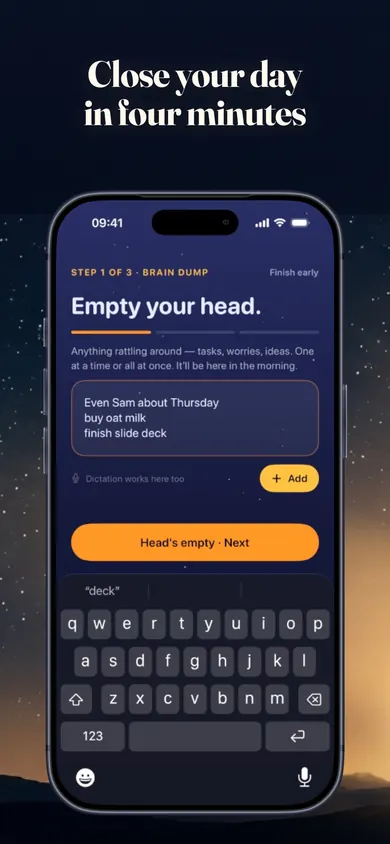
Lying down with a full head

StopRehearsing tomorrow's to-do list in the dark.

StartSpend five minutes writing it down before bed, then close the notebook.

In a 2018 Baylor study of 57 adults (Journal of Experimental Psychology: General), five minutes writing a to-do list at bedtime helped people fall asleep faster than writing about tasks already done.

4

The phone comes to bed

Stop"Just checking one thing" with the lights off.

StartPut it down at least 30 minutes before bed, out of arm's reach if you can.

CDC: turn off electronic devices at least 30 minutes before bedtime.

5

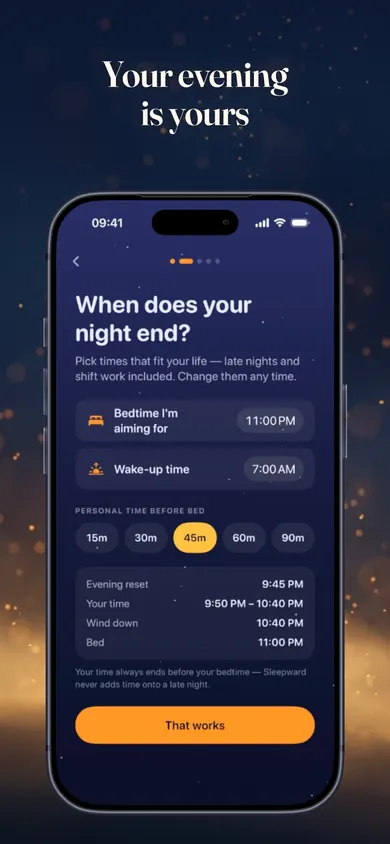
There's no time that's just yours

StopStealing personal time from sleep because the evening went to everyone else.

StartSchedule a protected hour that ends before bedtime. We wrote more on revenge bedtime procrastination.

6

Grading every night by a sleep score

StopTreating a tracker's number as a verdict on how you'll feel.

StartCheck in with how you actually feel, and hide numbers if they make you anxious.

Sleep researchers coined "orthosomnia" in a 2017 Journal of Clinical Sleep Medicine case series for people whose pursuit of perfect tracker data added stress.

7

Late coffee, big dinners, a nightcap

StopThe 4 pm coffee and the large meal at 9.

StartKeep caffeine to the morning and finish big meals and alcohol well before bed.

CDC: avoid large meals and alcohol before bedtime, and caffeine in the afternoon or evening.

Mistakes vs fixes, at a glance

What usually fails

  • 45-minute routines
  • A different bedtime each night
  • Planning tomorrow in the dark
  • Phone in bed
  • Sleep scores as grades

What tends to stick

  • A four-minute core
  • Bed and wake times kept close
  • Five minutes of writing first
  • Phone down 30 minutes early
  • How you feel, not the number

Which mistakes are yours? Build a four-minute fix

Tick what sounds familiar and set your bedtime. You'll get your top three fixes and a timed evening.

This sounds like me

Who should pick something else

  • If you've had trouble sleeping for weeks, snore loudly, or feel exhausted however long you sleep, see a clinician. Routines don't treat insomnia or sleep apnea, and Sleepward doesn't diagnose or treat any sleep condition.
  • If you want detailed sleep-stage data, a dedicated tracker will do more. Sleepward never scores your sleep.
  • If you need a reliable alarm, keep your Clock app. Sleepward's wake-up reminder is a notification that Silent mode or Focus can quiet.

This is general information, not medical advice. Talk to your clinician.

Honest limits, and what Sleepward does

Sleepward is a four-minute evening reset: a private Brain Dump, up to three things for tomorrow, Your Hour of protected personal time that always ends before your bedtime, then a darkening wind-down screen with free white, pink and brown noise and a fade-out timer.

Sleepward Brain Dump step with tasks typed into a list and a Head's empty, Next button
Mistake 3, fixed: the Brain Dump.
Sleepward evening plan with bedtime, wake-up time and personal time before bed
Mistake 5, fixed: Your Hour ends before bed.

Our design decision: Sleepward never scores your sleep and never breaks a chain. Grace Nights mean nothing resets, and you can hide all numbers. The honest limit: an app can make stopping easier, but it can't put the phone down for you. The core is free forever; optional Pro adds more world chapters and studio soundscapes.

Questions about bedtime routines

How long should a bedtime routine be?
Short enough to finish on a bad night. A four-minute core, such as writing down what's on your mind and picking tomorrow's main task, survives tired evenings. Longer extras like reading are fine as optional add-ons.
When should I stop using my phone before bed?
The CDC suggests turning off electronic devices at least 30 minutes before bedtime. Putting the phone out of arm's reach makes that easier.
Does writing a to-do list before bed help you sleep?
It may. In a 2018 Baylor University study of 57 adults, published in the Journal of Experimental Psychology: General, people who spent five minutes writing a to-do list at bedtime fell asleep faster than people who wrote about tasks they had already finished.
Can sleep trackers make sleep worse?
For some people. Researchers described "orthosomnia" in a 2017 Journal of Clinical Sleep Medicine case series, where the pursuit of perfect tracker data added stress. If numbers make you anxious, try going by how you feel instead.
Is Sleepward free?
Yes. The evening reset, Brain Dump, tomorrow's three things, Your Hour, wind-down, routines, Minimal Mode, sleep logs and white, pink and brown noise are free forever. Optional Pro adds all 13 world chapters and studio-recorded soundscapes.

Four minutes. Then the day is closed.

Empty your head, pick tomorrow's three, keep your hour, then put the phone down.

Download on the App StoreFree on iPhoneStart on your iPhone

Sources: CDC, About Sleep (reviewed Nov 2023) · Scullin et al., J Exp Psychol Gen 2018, via ScienceDaily · Rush University on Baron et al., orthosomnia (2017)

More from Small Health Habits