Is there a nutrition app that doesn't count calories?
Yes. If you want to understand food rather than tally it, look for a learning app: one that explains what nutrients do and where they work, with no daily target to hit. Body Unpacked (ours) and Nutrients Guide fit that description; Nutrina mixes learning with a meal journal; Cronometer is a tracker first.
Counting has its place, and plenty of people get real value from it. But some of us just want to know why spinach keeps showing up on lists, or what "iron absorption" actually means, without a running total. That's the gap this page is about.
Counting tells you how much. Learning tells you what it's for.
Nutrition apps without calorie counting, compared
We read each app's current US App Store description on November 3, 2026, and describe only what the listing says. We haven't scored them, because they're built for different jobs.
| Cronometer: Calorie Counter | Nutrina | Nutrients Guide | Body Unpacked (ours) | |
|---|---|---|---|---|
| Main job | Calorie, macro and nutrient tracking | Nutrient learning and meal journal | Nutrient reference | Food-to-body learning |
| Needs meal logging? | Yes, that's the core | Optional journal | No | No (optional journal) |
| Calorie goal | Yes | Tracks calories in journal | No | No |
| Food database | 1.1 million+ verified foods | Ranked top foods and dishes | Food sources per nutrient | 44 everyday foods, USDA FoodData Central |
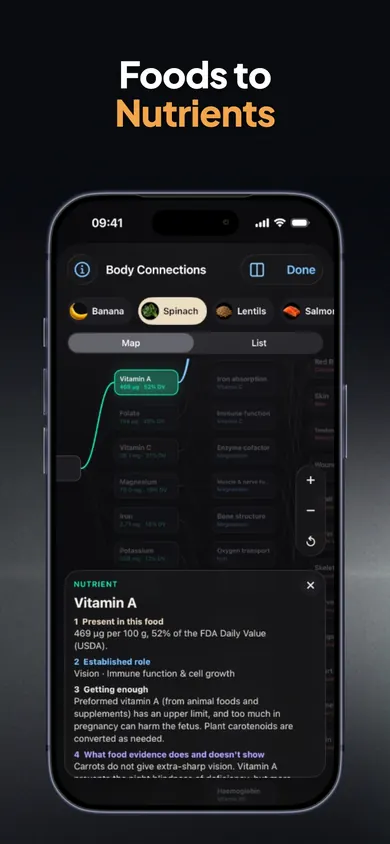
| Explains roles in the body | Not its focus | Fact sheets per nutrient | Yes, nutrient functions | Yes, with animated journeys for 14 nutrients |
| Evidence labels on claims | Not listed | "Science-based" fact sheets | Not listed | 23 statements labelled by evidence type and source |
| Rankings | Not listed | Ranked "best foods" | Not listed | No scores or "healthier" rankings |
| Best for | Precise tracking, dietitian-style detail | Spotting gaps while learning | Students and quick lookups | Curious learners who don't want to log |
Disclosure: Body Unpacked is made by us, Honest Little Apps. Sources: the US App Store listings for Cronometer: Calorie Counter (Cronometer Software Inc.), Nutrina (Craftwise) and Nutrients Guide, read November 3, 2026. Listings change; check them before you choose.
Pick the app for the job: trackers count, guides explain.
What the slider showed, written out
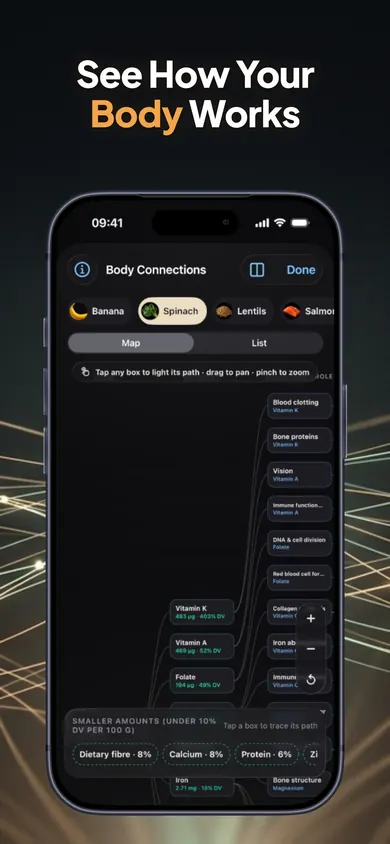
The counting view gives spinach one number. The explained view follows three of its nutrients to their jobs. Here's that path in plain text, with the public fact sheets behind it.
Per 100 g raw spinach (USDA)
- Vitamin K: 483 µg
- Vitamin A: 469 µg
- Folate: 194 µg
- Iron: 2.71 mg
What those nutrients do
- Vitamin K: blood clotting and bone proteins
- Iron: makes hemoglobin, which carries oxygen in red blood cells
- Folate: DNA and cell division
One detail most calorie apps skip: the NIH Office of Dietary Supplements iron fact sheet (updated August 2023) explains that the body doesn't absorb the nonheme iron in plant foods like spinach as well as the heme iron in animal foods, and that eating it with vitamin C-rich foods helps. The NIH calcium fact sheet (September 2023) notes that almost all of the body's calcium is stored in bones and teeth.
The same 23 calories carry a story about blood, oxygen and cells.
Who should pick something else
You need to track intake
For a medical diet, weight goal or sports plan, a tracker like Cronometer does what Body Unpacked doesn't.
You want personal advice
Body Unpacked gives no individual supplement or medication advice. A registered dietitian can.
You need clinician-reviewed content
Our content is checked by the developer against cited public sources; it hasn't been independently reviewed by a clinician.
Our design decision: no scores and no "healthier" rankings, just what each food contains and what the evidence says. The honest limit: 44 foods is a learning set, not a full database, and the body illustrations are simplified artwork made with AI-assisted tools. This is general information, not medical advice. Talk to your clinician.
Questions about learning nutrition without counting
Is there a nutrition app that doesn't count calories?
Yes. Learning apps such as Body Unpacked and Nutrients Guide explain what nutrients do without asking you to log meals. Body Unpacked has no calorie goal, no meal log requirement and no healthier-food rankings.
Can I learn which foods contain which vitamins without tracking my meals?
Yes. Body Unpacked lets you pick one of 44 everyday foods and see the nutrients it contains, with values from USDA FoodData Central. The NIH Office of Dietary Supplements also publishes free consumer fact sheets that list food sources for each vitamin and mineral.
Is Body Unpacked a replacement for a dietitian?
No. It provides general educational information, gives no individual supplement or medication advice, and its content has not been independently reviewed by a clinician. A registered dietitian can give advice for your own body and conditions.
Does Body Unpacked work offline?
Yes. All learning content is bundled in the app and works without a connection. There is no account, no ads and no analytics.
Inside Body Unpacked
Real App Store screenshots in our duotone. Hover or tap to see the original colors.
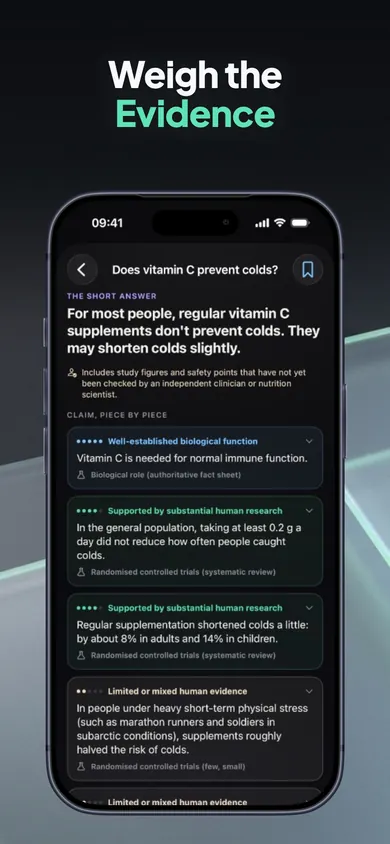
That vitamin C answer matches the NIH vitamin C fact sheet (March 2021): for most people, supplements don't reduce the risk of catching a cold, though people who take them regularly might have slightly shorter colds.
How to learn nutrition with Body Unpacked, in three steps
Pick a food
Choose one of 44 everyday foods and watch the graph draw itself: food, nutrients, roles, body places. Prefer text? The list view carries the same information for VoiceOver.
Follow a nutrient
Nutrient Journeys trace 14 nutrients on an animated body map: absorbed, carried, stored, used and removed, each with its source.
Weigh a claim
Evidence Lens breaks six popular questions into 23 statements, each labelled from established role to insufficient evidence.