What should I bring to a perimenopause appointment?
Bring a short list of your symptoms with how often and when they happen, the dates of your last few periods, every medication and supplement you take, and up to three written questions. Put the symptom that bothers you most at the top, and say it first.
That order comes from The Menopause Society's February 2024 advice: make a list of symptoms, how often they happen and what time of day, write questions down beforehand, and remember that a visit may only last about 15 minutes. If you don't get through everything, book a follow-up. The calculator above is that advice turned into minutes.
Some context worth knowing before you go: according to the National Institute on Aging (reviewed October 2024), most women begin the menopausal transition between 45 and 55, menopause is confirmed only after 12 months without a period, and the average age of menopause in the US is 52.
Fifteen minutes goes further when the most important sentence is the first one.
The perimenopause appointment checklist
Bring a pen
One week before
Log symptoms with dates and times
Hot flashes, night sweats, sleep, mood, brain fog, joint aches. How often, what time of day, how much they bother you.
Write down your last three period dates
Include any very heavy, very long or unusually close-together periods.
List every medication and supplement
Name, dose and how often, including anything over the counter.
The night before
Pick your main concern
One sentence. "Night sweats wake me three times a week and I'm exhausted at work."
Write up to three questions
For example: "Could this be perimenopause?", "What are my treatment options, hormonal and not?", "What else should we rule out?"
Note what you've already tried
A fan, cutting caffeine, sleep changes. It saves time and avoids repeat advice.
In the room
Say your main concern first
Before small talk, before the symptom list.
Mention the awkward ones
The Menopause Society specifically suggests raising bladder and sexual symptoms, which are easy to skip.
Ask what happens next
Tests, a follow-up date, what to track before then.
Three lists, one sentence, three questions. That's the whole kit.
Honest limits
Minutes in the calculator are our rough estimates. Your clinician runs the visit, and some topics take longer than you'd guess. Treat the meter as a nudge to prioritize, not a timetable.
My Midlife Story organizes your notes; it doesn't diagnose. It doesn't recommend treatment or doses, or say one thing caused another.
Who should pick something else: some things shouldn't wait for a planned appointment or a week of notes. Contact your doctor promptly for the signs below.
- Any vaginal bleeding 12 months or more after your last period (NIA and NHS both say get it checked)
- Bleeding after sex or between periods, or much heavier bleeding than before
- Palpitations, which the NHS (reviewed May 2026) lists as a reason to see a GP
A checklist helps a routine visit. It never replaces a prompt call.
Common questions
How long is a typical menopause appointment?
Do I need a blood test to be diagnosed with perimenopause?
What questions should I ask my doctor about perimenopause?
Should I track symptoms before the appointment?
Is My Midlife Story free?
Who this checklist is not for
If you're under 40 and your periods have stopped, or you've had surgery or cancer treatment that affects your ovaries, your appointment may need a different plan; ask your clinician what to bring. If you're already seeing a menopause specialist who gives you their own intake form, use theirs first. And if writing lists adds stress rather than relief, one sentence about your main concern is enough.
Bring what helps. Leave the rest at home.
How My Midlife Story turns notes into a visit brief
- 1
Log in one tap
Hot flash, foggy, poor sleep, overwhelmed: one tap saves the moment with its date and time. Add your own words when you want to. - 2
Keep every question
Save questions as they come up, and use "Something changed" when a symptom shifts or a treatment changes. - 3
Make the one-page brief
Pick your main concern, up to three questions and the notes to share. Preview, edit and save it as a PDF, print it, or share it only when you decide.
A tour of the real screens
App Store screenshots, marked up by us. Records shown are the app's fictional samples.
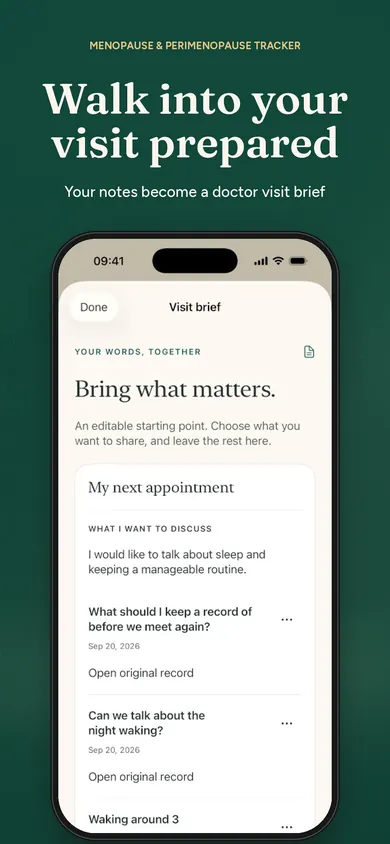 Main concern first
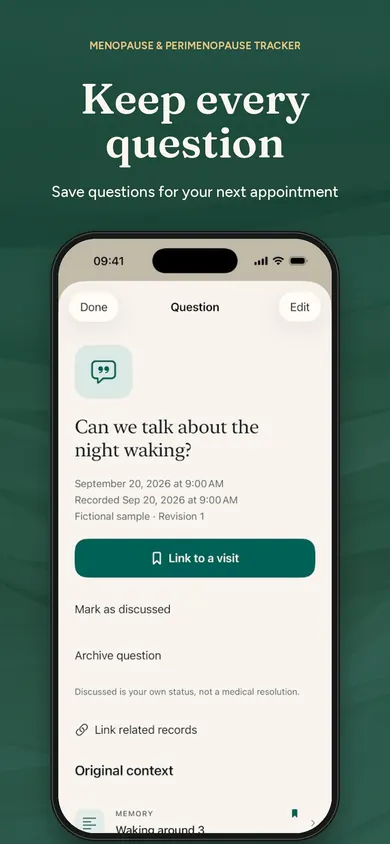 Questions, kept
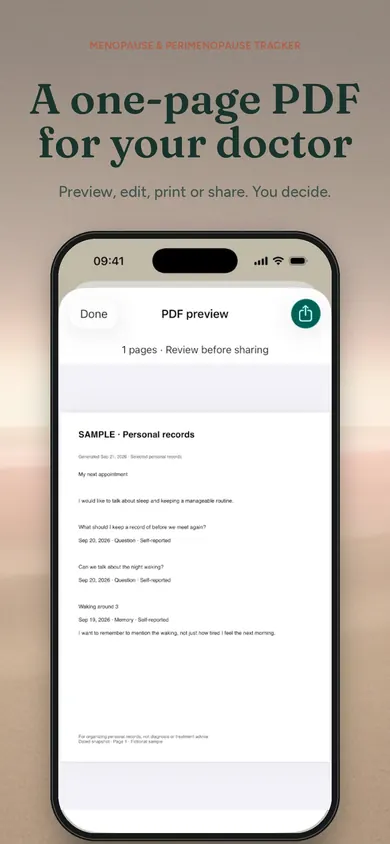 You decide to share
Our design decision: every line in the visit brief links back to your original note, so nothing gets reworded behind your back. No account, no ads, no tracking; records stay on your device. This is general information, not medical advice. Talk to your clinician.