Small Health HabitsSturdy guide

Updated November 2026 · by Honest Little Apps

Week One on GLP-1: 2 Strength Days, Done.

For adults on prescribed GLP-1 medication. Drag the blocks until no two strength days touch.

Drag a block (or focus its handle and use the arrow keys) to plan your first week.

    Download on the App Store Free on iPhoneOpen Sturdy in the App Store
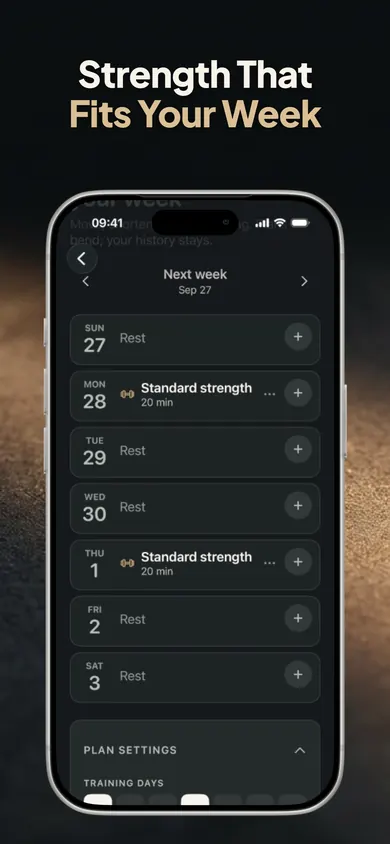
    Sturdy's weekly planner with two Standard strength sessions on Monday and Thursday

    What should the first week of strength training on GLP-1 look like?

    Two short strength sessions of about 20 minutes, on days that aren't back to back, with something light in between and protein at most meals. That's it. The CDC's adult activity overview (reviewed December 2023) asks for muscle-strengthening work on at least 2 days a week, covering legs, hips, back, abdomen, chest, shoulders and arms.

    Why bother in week one? In May 2025, four obesity and nutrition groups (ACLM, ASN, OMA and TOS) published a joint advisory on nutrition for GLP-1 therapy that lists "adequate protein intake and strength training to preserve lean mass" among its priorities. Starting small now makes it far easier to keep going later.

    A good first week is boring on purpose: two sessions, real rest, and nothing you'd dread repeating.

    A typical week, told plainly

    The week that goes sideways (and the fix)

    Here's a pattern we designed around. Someone starts their medication, reads that muscle matters, and books five gym days. Tuesday's dose day brings a flat, queasy afternoon. Wednesday's session gets skipped, then Thursday's, and by Saturday the whole plan feels like a failure.

    The fix isn't more willpower. It's a smaller week: two strength days with space between them, a five-minute fallback for rough days, and a plan that treats a missed day as an empty box rather than a broken streak.

    Plan the week for your heaviest day, not your best one.
    Your first week on GLP-1, day by day

    Swap the days to fit your life; the order matters more than the weekday. If you already know which days after a dose feel heavier, put Day 3 or Day 6 there.

    1. Day 1 · Set up

      Choose two days and one fallback

      Pick two strength days with at least one day between them, a session length (20 minutes is plenty) and what you have: a chair, a wall, maybe a pair of dumbbells. Then do five easy minutes of movement so the first session isn't a cold start.

      Optional baseline: the CDC STEADI 30-Second Chair Stand uses a chair without armrests (about a 17-inch seat), arms crossed at the chest, and counts full stands in 30 seconds. Write the number down and move on. It's a starting point, not a grade.

      In Sturdy: pick training days, session length, equipment and experience, and it builds a weekly plan you can move, shorten, skip or repeat. The chair stand is one of its optional check-ins.

    2. Day 2 · Strength 1

      Five movements, two or three easy sets

      • Chair squat (sit back to the chair edge, stand tall)
      • Wall push-up
      • Glute bridge
      • Hip hinge with hands on thighs
      • A slow march in place for balance

      Stop each set with a few reps left in the tank. Breathe out on the effort. Soreness the next day is normal; sharp pain is a reason to stop.

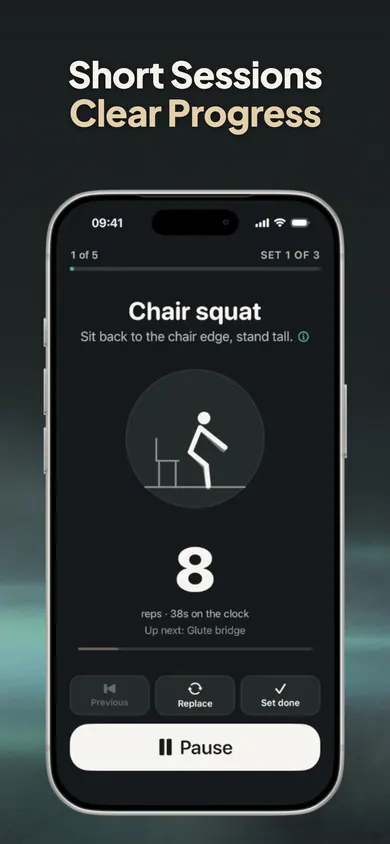
      In Sturdy: the guided player shows each movement with a timer, rep guidance and rest breaks. Pause, skip, replace a movement or end anytime.

    3. Day 3 · Rest

      Walk, eat, notice

      A short walk counts. Pay attention to protein: a source at breakfast, lunch and dinner is a simple target when appetite is low. Note how you feel. MedlinePlus (revised May 2026) lists nausea, vomiting, diarrhea, constipation and stomach pain among semaglutide's possible side effects, and these can shape which days feel trainable.

      In Sturdy: log protein by meal period, use quick-add foods, or switch to simple meal checkmarks if counting grams isn't for you. You set your own target.

    4. Day 4 · Recovery

      Mobility, not intensity

      Ten gentle minutes: hip circles, shoulder rolls, a calf stretch against the wall. If you feel good, a longer walk. If you don't, this is the day that bends.

      In Sturdy: Recovery & Mobility is one of three workout types, next to Quick Movement (about five minutes) and Standard Strength.

    5. Day 5 · Strength 2

      Same session, small notes

      Repeat Day 2. Resist the urge to add more. Write down the chair height, the reps and how hard it felt from 1 to 10. Next week's progress comes from these notes, not from guessing.

      In Sturdy: flag sore areas before a session and those movements are swapped out. Mark a movement uncomfortable and it's left out in future. Difficulty changes only when you choose.

    6. Day 6 · Rest or five minutes

      The fallback day

      If the week went to plan, rest. If you missed a session, don't double up; do a five-minute Quick Movement and let the week be what it was.

    7. Day 7 · Look back

      Three questions, one minute

      Which session felt doable? Which day after your dose was hardest? What would you ask your clinician? Keep the answers; they're the raw material for week two.

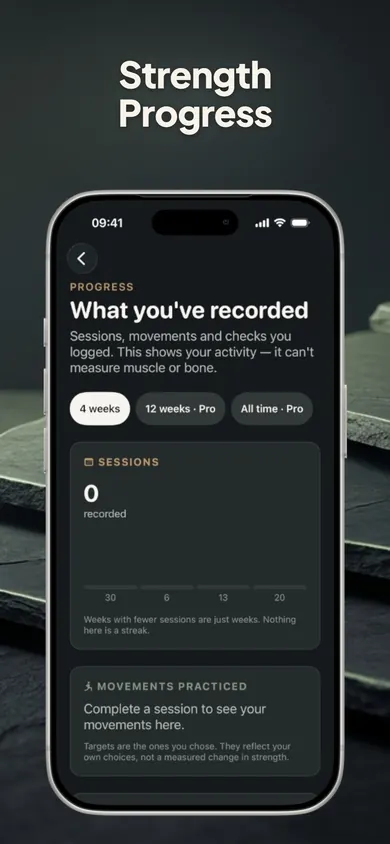
      In Sturdy: the progress view shows sessions, movements practiced and protein consistency. A journal holds symptoms and questions, and a 30-day PDF summary (you choose every section) can go to your appointment.

    Week one at a glance
    DayFocusTime
    1Set up + 5 minutes of movement~15 min
    2Strength 1~20 min
    3Rest, walk, proteinoptional
    4Recovery & mobility~10 min
    5Strength 2~20 min
    6Rest or 5-minute fallback0–5 min
    7Look back~1 min

    What the week looks like inside Sturdy

    Real App Store screenshots, with our notes on top.

    Sturdy weekly plan: Standard strength on Monday and Thursday, rest days between
    Two strength days with rest between, ready to move or skip.
    Sturdy guided session showing a chair squat with a rep counter and Pause button
    The guided player: reps, a clock, and Replace when a move doesn't suit you.
    Sturdy progress screen noting it shows recorded activity and cannot measure muscle or bone
    Progress shows what you recorded. It says plainly it can't measure muscle or bone.

    Who should pick something else

    We'd rather you start the right way than start with us. Sturdy is an organizing and self-tracking tool; it doesn't diagnose, treat or give medication advice.

    Recent injury, fracture, dizziness or pain

    See your clinician or a physical therapist before a new routine. A supervised start beats any app.

    You want dose guidance

    Sturdy never suggests doses or changes schedules. It records what you enter. Dose questions belong with your prescriber.

    You want body composition numbers

    Sturdy can't measure muscle, fat or bone. A DEXA scan or clinic measurement can, if your clinician thinks it's useful.

    You're already lifting four days a week

    You'll outgrow a beginner plan fast. A full program app or a coach will suit you better.

    Our design decision: missed days stay empty, never red. No streaks, no scores, no age norms. The honest limit: Sturdy shows effort and habits you logged, not what's happening inside your body. It's iPhone only and keeps records on your phone, with no account.

    Your sorted week, as a plan card

    Here's the week you arranged at the top of this page, written out. Print it, screenshot it, or stick it on the fridge. Change the order up top and this card changes too.

    My first strength week

      General information, not medical advice. Check with your clinician before starting exercise if you have a medical condition, injury, dizziness or pain.

      Questions about week one

      How many days a week should I strength train in my first week on GLP-1?

      Two is a sensible start. The CDC asks adults for muscle-strengthening activity on at least 2 days a week, and two short sessions with lighter days between them leave room for appetite changes, tiredness and normal life.

      Should I train on my injection day?

      There is no single rule. Many people simply notice which days feel heavier after a dose and put rest or a five-minute session there. If symptoms keep getting in the way of moving or eating, raise it with your prescriber.

      What if I feel too tired or queasy to do the session?

      Shorten it, swap it for a Quick Movement, or move it to another day. A first week is about showing up a little, not finishing every set. Stop and seek care for dizziness, chest pain or pain that does not settle.

      Do I need a gym for week one?

      No. A sturdy chair, a wall and some floor space cover a first week: chair squats, wall push-ups, glute bridges and a hip hinge. Sturdy lets you pick home or gym equipment when it builds your plan.

      Is Sturdy free?

      Yes, it is free to download. The free version includes weekly planning, all three workout types, the core movement library, sessions up to 30 minutes, protein logging, check-ins and 30-day summaries. Sturdy Pro is optional and adds gym-equipment movements, longer sessions and longer history.

      This is general information, not medical advice. Talk to your clinician. Sturdy is for adults using prescribed GLP-1 or other weight-management medication under medical care.

      Two sessions this week. Sturdy keeps the plan.

      Weekly plan, guided sessions, protein your way, and no account.

      Download on the App Store Free on iPhoneOpen Sturdy in the App Store

      More from Small Health Habits